

The Mother of the Bride Dress Checklist: Fit, Comfort, and Formality
Finding the right mother of the bride dress is one of those tasks that sounds straightforward until you are actually doing it. There are photographs to think about. The couple's preferences. The dress code. The venue. What the other mother is wearing. Whether you will be standing for six hours. Whether the room will be cold.
This checklist exists to cut through the noise. Work through it in order and the decision becomes considerably simpler — because you will know exactly what you are looking for before you start.

1. Confirm the basics with the couple first
Before you look at a single dress, get three things confirmed with the bride and groom:
-
The dress code. Cocktail, formal, black tie, garden party — each one sets a different level of formality and changes the entire range of appropriate options.
-
The color palette. Some couples have strong preferences; others do not mind at all. Ask once, directly, so you are not second-guessing later.
-
Any colors to avoid. Usually this means staying away from white, ivory, and the exact bridesmaid shade. Beyond that, most couples are happy for the mother of the bride to wear what she loves.
Having this information in hand before you shop means every dress you consider is already appropriate. You are choosing from the right pool, not filtering out of a wrong one.
2. Decide on your length
Length is one of the most practical decisions you will make, and it is worth settling early because it significantly narrows the field.
-
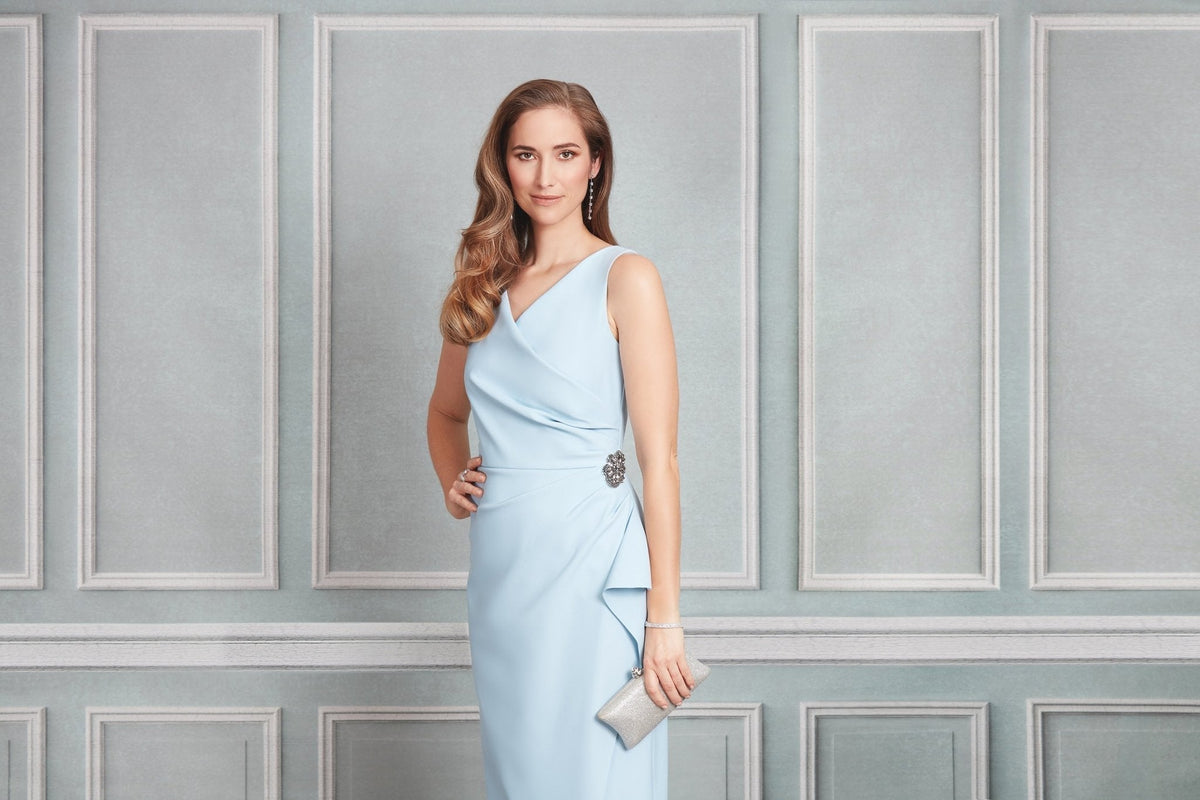
Floor length suits formal evening weddings and black tie events. A long mother of the bride dress in a rich fabric reads as complete and considered and works beautifully in photographs.
-
Tea length is the most versatile option — elevated enough for a formal occasion, comfortable enough for a long day. Tea-length mother of the bride dresses suit garden weddings, daytime ceremonies, and any setting where a full-length gown might feel over-formal.
-
Knee length works well for daytime and semi-formal weddings. Short mother of the bride dresses in refined fabrics with beautiful details can be just as elegant as a longer option — and are often more comfortable to move in across a full day.
If you are petite, note that length lands differently on a smaller frame. Petite mother of the bride dresses are cut proportionally so that tea-length hits at tea-length, and floor-length doesn't pool.

3. Think about sleeve preference early
Sleeve choice is often an afterthought — but it shouldn't be. It affects comfort, how the dress photographs, whether you need a cover-up, and how you feel throughout the day.
-
Sleeveless works well for warmer venues and summer weddings, especially if you plan to wear a wrap for the ceremony
-
Short and cap sleeve offers light coverage that suits daytime events and warmer months without heaviness
-
Three-quarter and long sleeve is ideal for evening events and cooler venues — it adds elegance and eliminates the need for a separate cover-up
-
Off-the-shoulder is a more modern neckline that covers the upper arm while opening up the shoulder — genuinely flattering and current
The right choice is the one you will forget you are wearing. If you spend the evening pulling at a sleeve or wishing you had chosen differently, that is a fitting room problem, not a wedding day problem.

4. Check the fit criteria
This is the most important section of the checklist, and the one most worth taking time over.
Fit across the body
A dress that fits well is a dress that requires no adjustment throughout the day. Check these points when trying on:
-
The shoulder seam should sit at the edge of the shoulder, not falling off or pulling inward
-
The bodice should lie flat with no pulling across the chest or back
-
The waist should hit at your natural waist, not below it
-
The skirt should fall cleanly from the hip without pulling or bunching
Room to move
You will be standing, sitting, hugging people, getting in and out of cars, walking across grass, and probably dancing. Try all of this in the fitting room. Reach your arms forward. Sit down fully. Walk across the room. A dress that only looks good standing still is not the right dress.
Fabric that works with your body
Some fabrics are more forgiving than others. Stretch crepe and jersey move with the body and smooth without constricting — styles from the contour collection are specifically designed to sculpt and support. Chiffon and lace are softer and more fluid. Structured fabrics like taffeta and jacquard hold their shape independently, which can be flattering but less forgiving of movement.
Size range
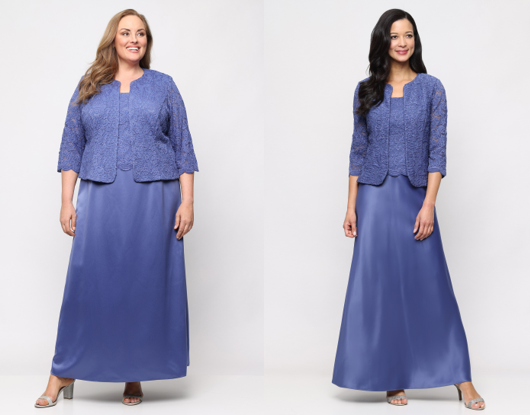
If you are shopping in plus sizes, plus size mother of the bride dresses are cut for fuller figures from the pattern up — not scaled from a smaller size. The difference in how the fabric lies and how the waist sits is significant.

5. Think about comfort across a full day
A wedding is typically a six-to-eight hour event. The dress needs to work for all of it — not just the ceremony.
Ask yourself:
-
Will I be warm enough? If the venue is outdoors, a country house, or a church in autumn, factor in temperature. A three-quarter sleeve or a coordinating jacket eliminates the need for a separate cover-up.
-
Will I be too warm? Air conditioning is powerful in most ballrooms. Sleeveless with a wrap gives you flexibility; a long sleeve in a heavy fabric may not.
-
Can I eat comfortably in this? A fitted bodice that feels fine when you are standing can feel significantly tighter after a three-course meal. Allow for this.
-
Can I dance in this? If dancing is likely, a skirt with movement — chiffon, a flared hem, a split — is worth considering.
-
Are my shoes sorted? Heel height affects how a hemline falls. Bring the shoes you plan to wear to any fitting.

6. Coordinate without matching
Most couples want the mothers to look harmonious in photographs without wearing identical outfits. The practical approach: agree on a color family rather than a specific shade, and a rough level of formality.
Some combinations that work well:
-
One mother in navy, the other in soft blue or periwinkle
-
One in champagne, the other in gold or a warm blush
-
One in a deep jewel tone, the other in a coordinating shade at a similar depth
-
One in a floral print, the other in a clean solid that picks up one of the floral colors
The mother of the bride dress collection spans a wide range of colors, silhouettes, and sleeve lengths — which makes it straightforward for both mothers to find something that works within a shared palette without either compromising on her own style.

7. Plan your timeline
This is the checklist item most often left too late.
-
Start shopping four to six months before the wedding. This gives you time for alterations, to reconsider if the first choice doesn't work out, and to order in time if the style is not immediately available in your size.
-
Confirm alterations are included or available. Even a dress that fits well off the rack often needs minor adjustments at the hem or waist.
-
Bring someone whose opinion you trust — but not so many people that the decision becomes a committee. One person who knows your style and will be honest is worth more than five enthusiastic but unhelpful opinions.
-
Try on more than one style. The dress you assumed would not suit you is often the one you end up wearing. Give yourself the freedom to be surprised.
8. The final check
Before you commit, run through this list:
-
[ ] I have confirmed the dress code, color palette, and any colors to avoid with the couple
-
[ ] The length is appropriate for the venue and formality
-
[ ] The sleeve choice suits the season and my personal preference
-
[ ] The fit is correct at the shoulder, bodice, waist, and hem
-
[ ] I can move, sit, eat, and dance comfortably in this dress
-
[ ] The fabric suits the setting and the time of year
-
[ ] I have allowed enough time for alterations if needed
-
[ ] I feel like myself in it
That last point is the one that matters most. The right mother of the bride dress is not the most expensive one, or the one with the most detail, or the one that photographs best in theory. It is the one you put on and feel ready. Everything else on the checklist exists to get you there.

Leave a comment
This site is protected by hCaptcha and the hCaptcha Privacy Policy and Terms of Service apply.